Publications
Curated collection of academic research and technical documentation on horn mute design, acoustics, and historical development.
Author: Nicholas Smith
Institution: Eastman School of Music
Year: 1980
Comprehensive examination of horn mute uses and acoustical effects across four chapters. Includes chronological study of mute history, makers and design progress, in-depth analysis of muted horn parts in Second Viennese School composers (Schoenberg, Berg, Webern), and acoustical measurements including frequency response and sound pressure levels. Bibliography includes 80+ sources.
Authors: Shigeru Yoshikawa, Yu Nobara
Year: 2017
Pages: 143-186
Mutes for brass instruments are placed in the bell and change the instrument resonance characteristics. Since the pitch, loudness, and timbre are then affected, brass mutes are important for musical expression. Main focus is on the acoustical modeling of the straight mute for the French horn and the cup mute for the trumpet. The validity of the numerical analysis is confirmed by the results on the hand stopping and the stopping mute for the horn. An application of the modeling method to other trumpet mutes is furthermore demonstrated.
Author: Dr. Nicholas Smith
Source: The Hornsmith
Year: 1980 (revised)
Comprehensive historical study from early 18th century through modern designs. Documents evolution from wooden conical mutes to Hampl's non-transposing design, chromatic stopping mutes, French school developments, German/Austrian innovations by Wagner and others, and 20th century designs including Parduba, de Polis, and Rittich mutes. Includes musical examples from Beethoven, Wagner, Mahler, Strauss, and Second Viennese School composers.
Inventor: Michael Jarosz, Elena Jarosz
Filed: May 3, 2018
Issued: May 12, 2020
An ornamental design for an internal mute for brass musical instruments featuring a bell-shaped body with textured truncated cone near the upper portion. This design patent protects the aesthetic appearance of the mute rather than its functional aspects.

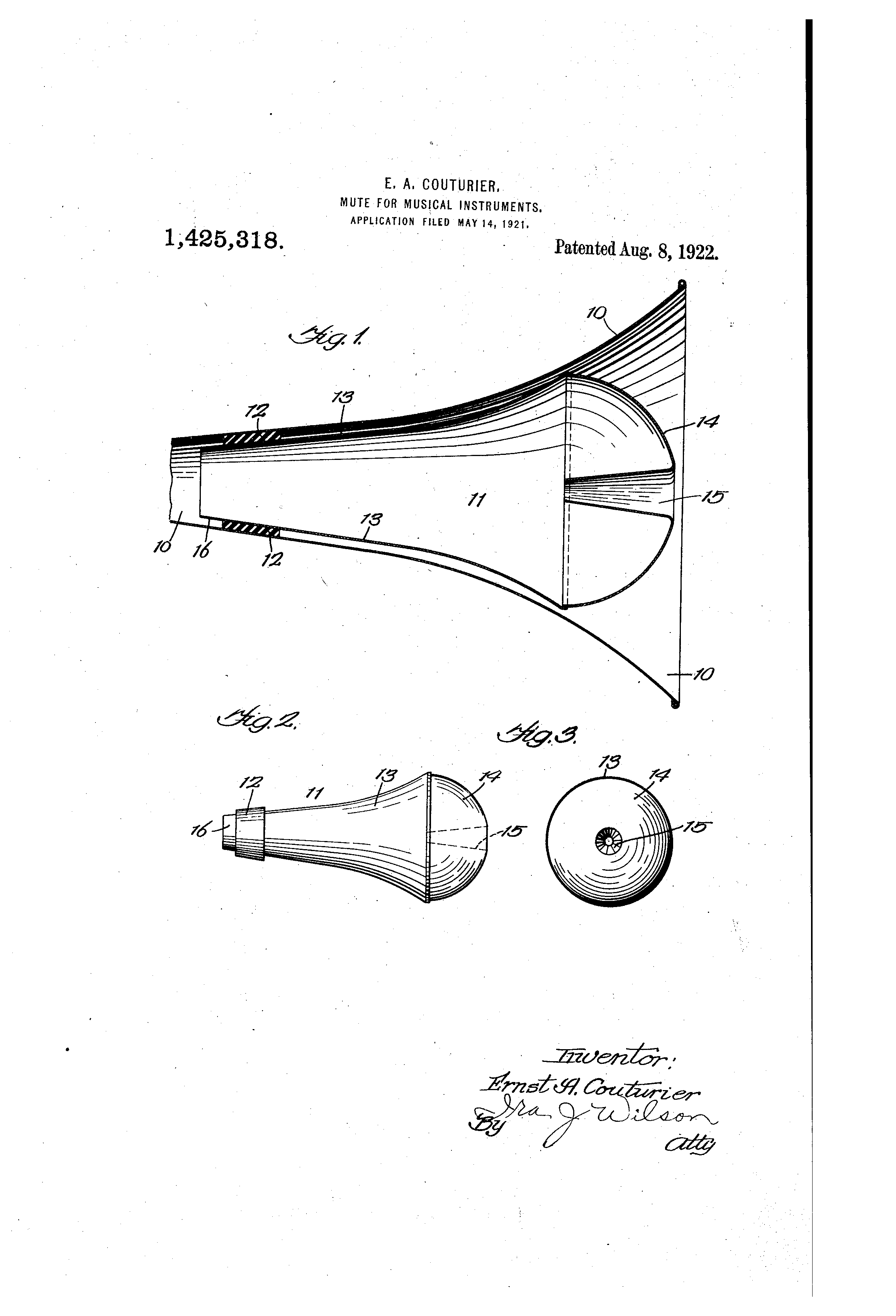
Inventor: Ernst A. Couturier
Filed: May 14, 1921
Issued: August 8, 1922
A mute comprising a bell-shaped tubular body with an outwardly convex hemispherical closure and a re-entrant sound delivery tube that tapers inwardly. The design produces miniature tones while retaining perfect intonation and normal quality. The mute is held out of contact with the bell by a rubber annulus, allowing it to respond freely to sound vibrations.
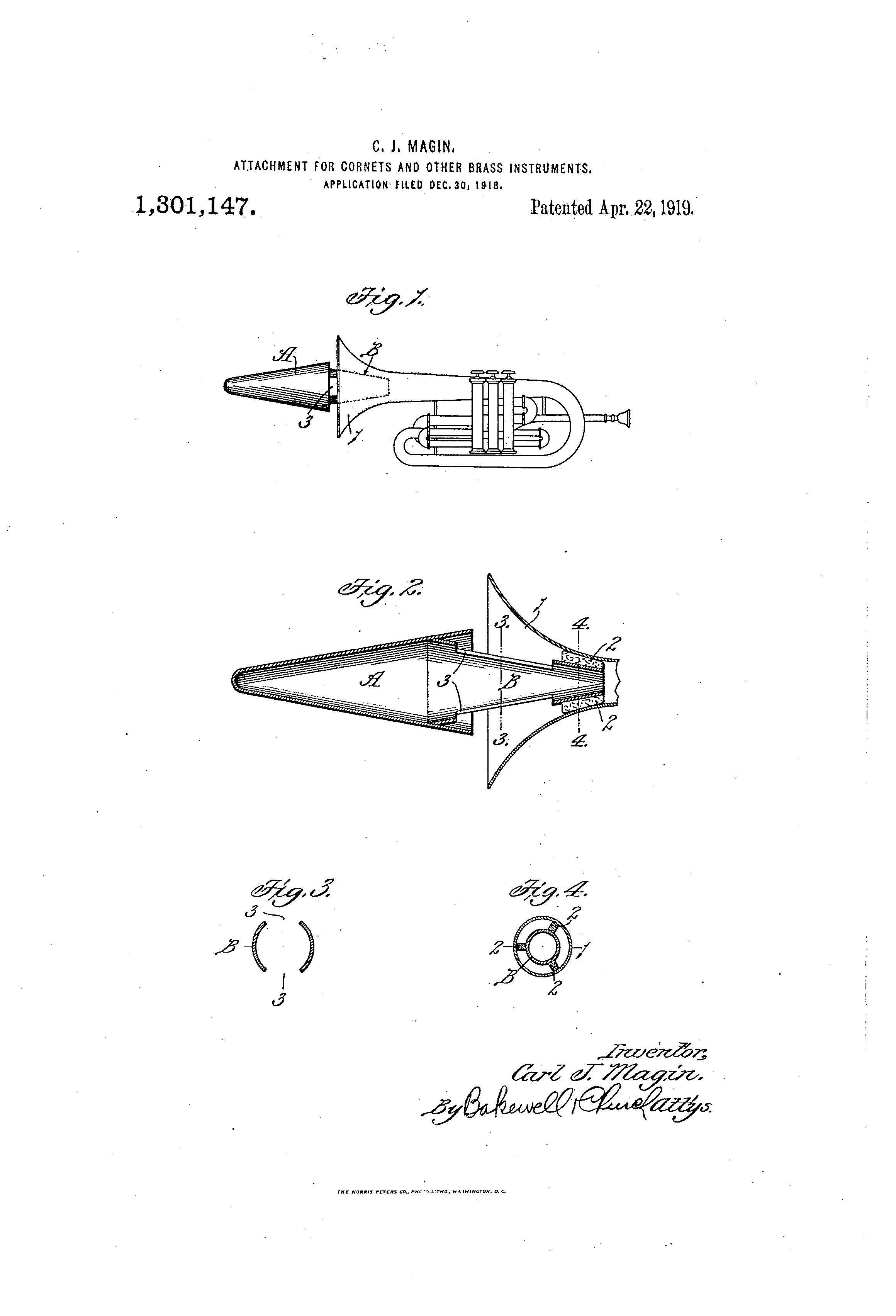
Inventor: Carl J. Magin
Filed: December 30, 1918
Issued: April 22, 1919
A device for changing the tone of brass instruments, consisting of a hollow cone-shaped member closed at its apex, with an oppositely-disposed frusto-conical member that inserts into the bell. The design converts the natural tone into a relatively deep tone, making instruments sound substantially like a saxophone. Features elongated slots to prevent interference with sound waves.
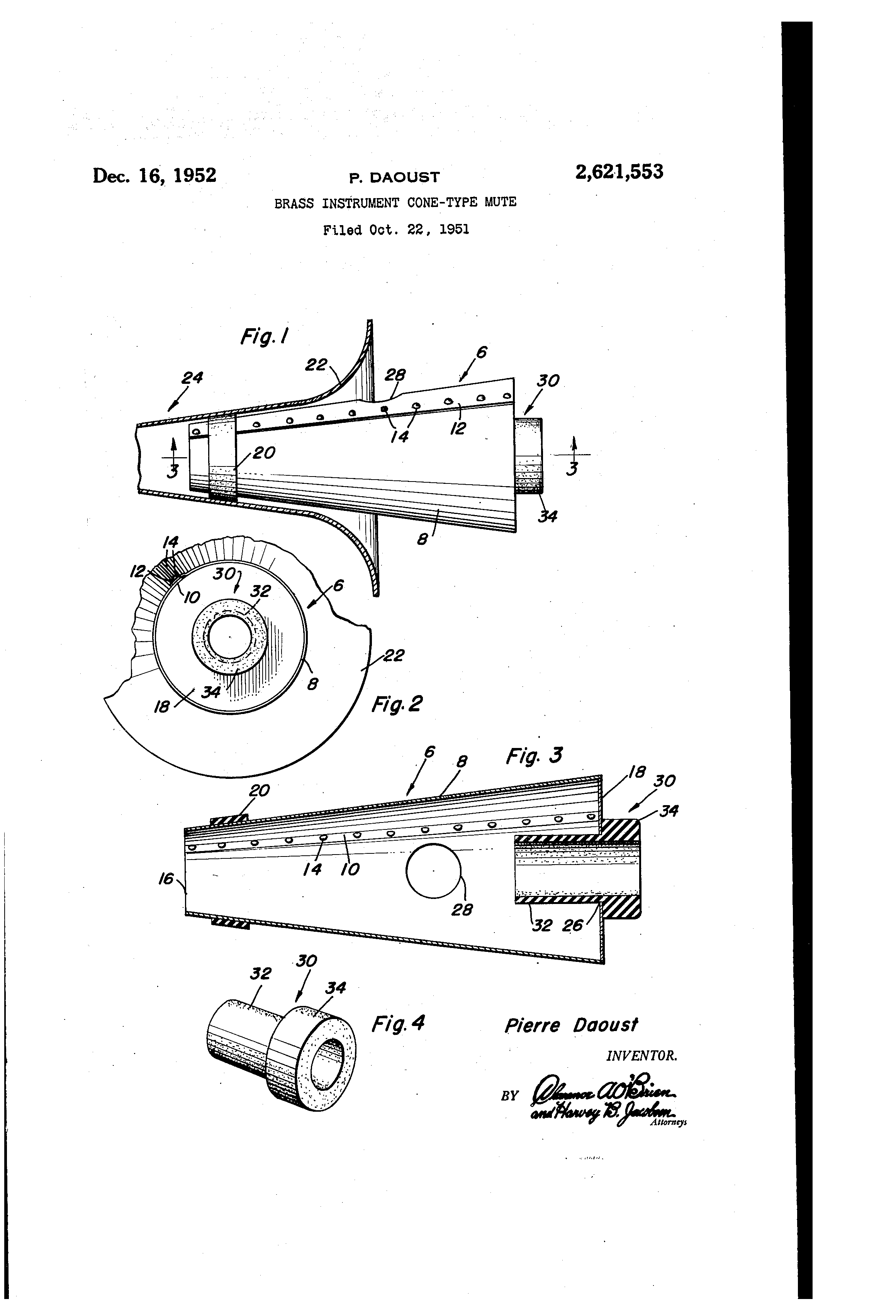
Inventor: Pierre Daoust
Filed: October 22, 1951
Issued: December 16, 1952
A hollow truncated conical mute with a central tone discharge hole in the flat outer end and a complemental smaller hole in the side wall. Features a removable resilient reducer sleeve that fits into the central hole to produce different tone qualities. The design offers two-way performance, allowing musicians to select between distinct tonal characteristics by inserting or removing the plug.
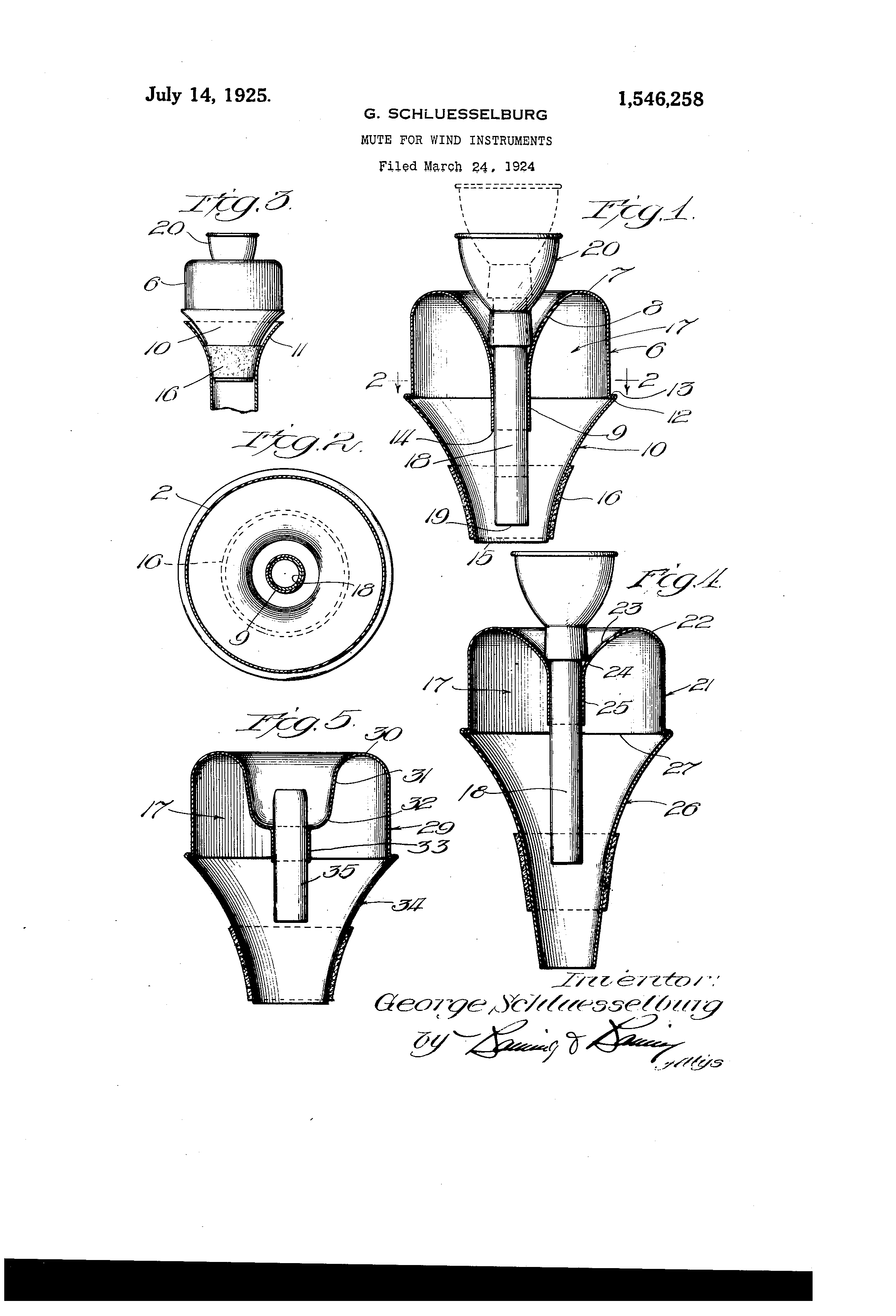
Inventor: George Schluesselburg
Filed: March 24, 1924
Issued: July 14, 1925
A self-contained mute with a cylindrical shell having an inwardly curved front portion terminating in a rearwardly-extending neck, paired with an outwardly flared rear section. Features an optional adjustable tube within the neck for varying tone. Designed to avoid trapping air and to produce beautiful, soft tones while eliminating undesirable metallic sounds and minimizing back pressure on the player.
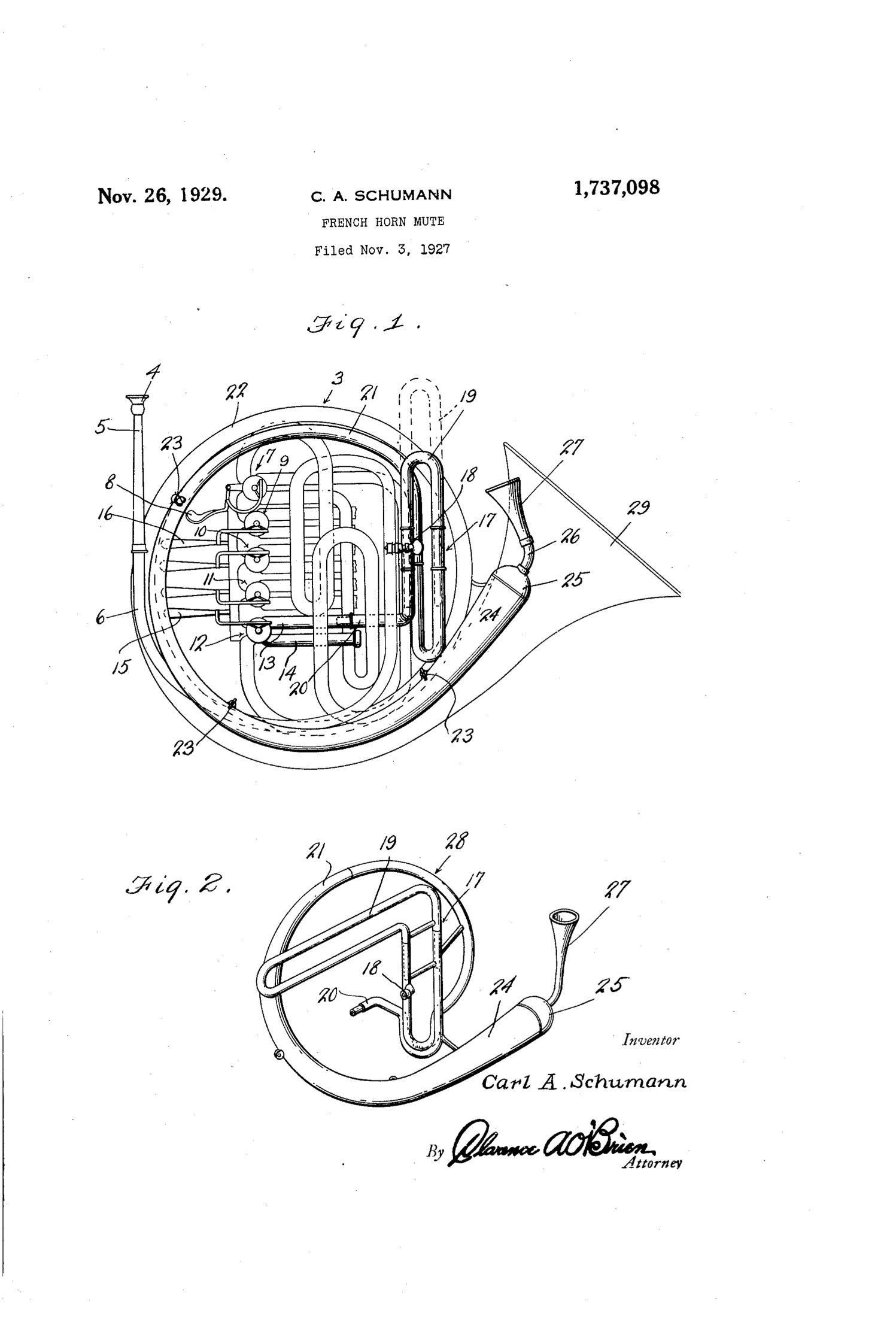
Inventor: Carl A. Schumann
Filed: November 3, 1927
Issued: November 26, 1929
An integrated French horn mute system controlled by an auxiliary valve placed alongside the main valve cluster. The design routes sound through a tapered coiled mute with its own small bell and tuning slide, allowing the performer to switch rapidly between open and muted tones without hand-stopping or inserting a separate plug mute.
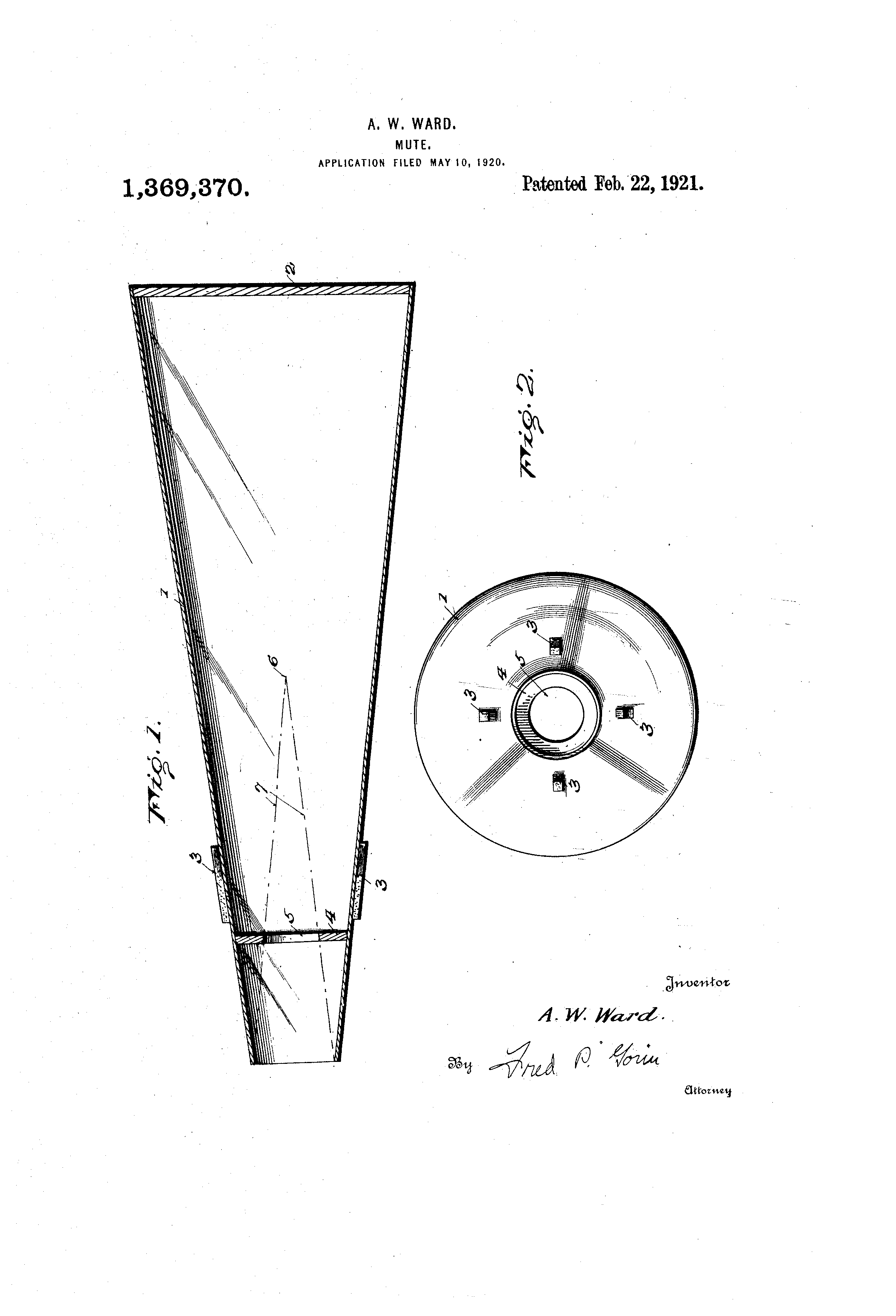
Inventor: Andrew W. Ward
Filed: May 10, 1920
Issued: February 22, 1921
A conical mute with a closed outer end and a pitch modifier mounted internally at a precisely calculated distance from the small opening (1.5 times the opening diameter). The modifier has an opening sized by geometric intersection to reduce vibrations, allowing the mute to produce the same pitch as the open instrument while reducing volume. Designed especially for accompanying singers with softer, more harmonious tones.